Showing posts with label Media. Show all posts
Showing posts with label Media. Show all posts
Tuesday, March 30, 2010


Thursday, March 11, 2010
'I want my... holographic karaoke'
I've just been at a conference on the future of media. I met some cool, smart people and it was an entertaining couple of days. I first started going to these sort of gatherings in the mid-1990s, and even if the players and the technologies have changed, the fundamental challenge is still the same - monetizing content.
The creative industries are perpetually wrestling with three basic questions: what is the audience prepared to pay for, will they pay enough (or will enough of them pay) to make producing it worthwhile, and if so, what's the best way to deliver it to them?
Meanwhile, notoriously fickle consumers have become complacent that something newer and better is always around the corner and, increasingly, they're expecting not to have to put their hand in their pocket for it.
I worked in 'conventional media' for nearly a quarter century, and one thing I know now is that the landscape is, more than ever, less about protecting what you already create and more about finding what you will need to create five or ten or twenty years from now.
There's a track record of innovation through functionality driving demand – look at models like Netflix, Shazam, Pandora, mp3ify, or even the iPod itself, for not just changing how consumers purchase content, but the very way they discover and interact with it.
Above all, the key is being able to admit that the 'model that's always worked' only worked because consumers were used to doing things that way. That's not going to be the case for much longer - as one panellist said at the conference, "we're not at a moment of transition, we're at a moment of destruction" - and the companies who can adapt to an environment where they're more responsive to consumer needs, and less dependent on their dying, so-called 'core' products, are the ones who will thrive.
Anyway, here's my totally bluesky wishlist for something that's 'next generation' as opposed to just 'next upgrade'. And it's something I'd willingly pay for if someone - Disney, EA, NewsCorp, whoever - can deliver it to me. I suspect I'll be waiting a while, though.
The original Guitar Hero game launched five years ago - and Rock Band two years later - and even now, in spite of tremendous improvements, and regardless of the artist catalogs they're able to sign up, and the more sophisticated on-screen avatars they can offer, their model seems stuck.
It needs something more, well, real. And I think there's a crucial demographic they're missing - people who can actually play an instrument rather than just manipulate a controller.
I want to plug in a real guitar and be able to play alongside holograms of my favorite artists. When I sign up for a performer's 'channel' I'll be able to jam with their images or, crucially, with other members of the channel, with social/community functionality wrapped around the content (and of course any advertising and merchandising opportunities that go along with that).
Imagine tapping into the highest-grossing concert tours worldwide on an annual basis: currently, performers like:
- U2
- Bruce Springsteen
- Rolling Stones
- Madonna
- Taylor Swift
- Jay-Z
- Britney Spears
- Dave Matthews Band
as well as archive or back catalog material - even from artists who may no longer be with us.
There were apparently more views for the streamed U2 concert online last year than tickets sold for all other rock concerts put together in 2009, and you only have to took at the popularity of the 'Met in HD' series, to see the appeal of an experiential combination of quality and exclusivity. It's only a matter of time before we see widespread concerts in HD at movie theaters then at home – an intermediate step to a fully immersive, holographic platform.
While there is effectively 3D functionality in a lot of existing game environments, the next wave of gaming will be around 3D control – increasingly, using your body as the controller, something that the Nintendo Wii has set in train, and which Sony recently moved forward.
So, looking way beyond that, what would you get with the holographic gig - what I call "Playalong"?
* It's both participatory and passive: you can either watch or take part – there might be different pricing plans for both, but it's designed to encourage people who start off just watching to do it themselves.
* It's incentivized – there'd be a ‘best performance of the day’ award – voted by members of the community who can view past performances of songs they play on video – and those are rewarded with points and/or merchandise.
* Advertising can either follow the content or the audience, but has to always have some relevance to the performer – ie – merchandising or rare downloads. You could also have a 'premium' subscription level option that removes advertising altogether and includes exclusive content: artists already do that with online 'fan clubs' whose primary function for the subscriber is pre-sale concert tickets.
Of course there are structural commercial problems - aggregation of rights is probably the biggest non-technical hurdle, but once the artists realize how much there is to be made from what is effectively a new platform for content distribution, they'd make it work. Technically, we'd be looking at something like a Home Theater system, only with sensors/projectors instead of speakers. But the important thing is the networked capability.
Research seems to show that people currently have a tolerance for only two boxes in their living room - a cable/satellite receiver box and a game system. There are roughly 125m US TV households (about 99 per cent market penetration). But we are looking at a globally networked environment. Microsoft's XBox has about 39m consoles worldwide – crucially, 23m of those are subscribing to the XBox live service.
So this service would likely initially piggyback on an existing game system. But growth of any 'new, new thing' can be dramatic and rapid, and force users to re-evaluate what they previously thought of as standard. There are other potential applications for the platform based on existing and new proprietary content, for example, experiential part-game/part-movies, where players affect outcomes by triggering alternate plot routes.
And of course, the concept is scalable and upgradable; every time there's a new album, the user can download both the 'rehearsal' version and the 'studio' version of the tracks, as well as live options once the tour begins. This way, the artist can monetize multiple individual performances of their content, as well as just the recorded staple.
Maybe charging for the service might work best on a Netflix model – unlimited usage for a monthly subscription - maybe with a joining fee and premium add-ons for things like tutorials, but what you'd get as the consumer would be:
- A compelling user experience
- Offers exclusivity of access
- Has many options to choose from (you can sing, play guitar, bass, keyboards whatever, and play in a 'rehearsal studio' or live)
- Play that's potentially different every time (you can choose things like arrangements; do you play solo or with the full band, or even venue; do you play at the Ryman Auditorium, Maxwell's in Hoboken or Wembley Stadium?)
Tracks would be recordable, so you can relive your triumphs and replay them, or you can use the studio option to put together demos, either on your own, or in collaboration with other members of the channel, which in turn could be uploadable for others to sample.
Is there a mobile app? No. it‘s fundamentally a home entertainment, multi-player living room experience. But you will be able to use your mobile phone to connect with the communities you're a member of in order to schedule jams / performances etc. or download new tracks. Or your phone can alert you to newly released content, or about other performers you might also be interested in, given your profile.
Of course, we're a long way away from working out the economics, and the existing technology is probably very much in its infancy. The audio technology's already available in karaoke versions of songs with tracks stripped out. It's the visual, interactive platform that will provide the all-round experience. For public performance, existing karaoke bars wouldn't need any additional space than they already use.
For the home version, we're probably looking at a post-3D intermediate stage involving a body suit or wrap-around glasses, but the key thing is that you'd be creating real music, with real instruments; not just mindlessly replicating some emotionless sequence of colored buttons.
And that's what will make it worthwhile, and worth paying for.
So, like my idea a couple of years back for a reality TV show, if I can help make this come about in any way, drop me an email.
The creative industries are perpetually wrestling with three basic questions: what is the audience prepared to pay for, will they pay enough (or will enough of them pay) to make producing it worthwhile, and if so, what's the best way to deliver it to them?
Meanwhile, notoriously fickle consumers have become complacent that something newer and better is always around the corner and, increasingly, they're expecting not to have to put their hand in their pocket for it.
I worked in 'conventional media' for nearly a quarter century, and one thing I know now is that the landscape is, more than ever, less about protecting what you already create and more about finding what you will need to create five or ten or twenty years from now.
There's a track record of innovation through functionality driving demand – look at models like Netflix, Shazam, Pandora, mp3ify, or even the iPod itself, for not just changing how consumers purchase content, but the very way they discover and interact with it.
Above all, the key is being able to admit that the 'model that's always worked' only worked because consumers were used to doing things that way. That's not going to be the case for much longer - as one panellist said at the conference, "we're not at a moment of transition, we're at a moment of destruction" - and the companies who can adapt to an environment where they're more responsive to consumer needs, and less dependent on their dying, so-called 'core' products, are the ones who will thrive.
Anyway, here's my totally bluesky wishlist for something that's 'next generation' as opposed to just 'next upgrade'. And it's something I'd willingly pay for if someone - Disney, EA, NewsCorp, whoever - can deliver it to me. I suspect I'll be waiting a while, though.
The original Guitar Hero game launched five years ago - and Rock Band two years later - and even now, in spite of tremendous improvements, and regardless of the artist catalogs they're able to sign up, and the more sophisticated on-screen avatars they can offer, their model seems stuck.
It needs something more, well, real. And I think there's a crucial demographic they're missing - people who can actually play an instrument rather than just manipulate a controller.
I want to plug in a real guitar and be able to play alongside holograms of my favorite artists. When I sign up for a performer's 'channel' I'll be able to jam with their images or, crucially, with other members of the channel, with social/community functionality wrapped around the content (and of course any advertising and merchandising opportunities that go along with that).
Imagine tapping into the highest-grossing concert tours worldwide on an annual basis: currently, performers like:
- U2
- Bruce Springsteen
- Rolling Stones
- Madonna
- Taylor Swift
- Jay-Z
- Britney Spears
- Dave Matthews Band
as well as archive or back catalog material - even from artists who may no longer be with us.
There were apparently more views for the streamed U2 concert online last year than tickets sold for all other rock concerts put together in 2009, and you only have to took at the popularity of the 'Met in HD' series, to see the appeal of an experiential combination of quality and exclusivity. It's only a matter of time before we see widespread concerts in HD at movie theaters then at home – an intermediate step to a fully immersive, holographic platform.
While there is effectively 3D functionality in a lot of existing game environments, the next wave of gaming will be around 3D control – increasingly, using your body as the controller, something that the Nintendo Wii has set in train, and which Sony recently moved forward.
So, looking way beyond that, what would you get with the holographic gig - what I call "Playalong"?
* It's both participatory and passive: you can either watch or take part – there might be different pricing plans for both, but it's designed to encourage people who start off just watching to do it themselves.
* It's incentivized – there'd be a ‘best performance of the day’ award – voted by members of the community who can view past performances of songs they play on video – and those are rewarded with points and/or merchandise.
* Advertising can either follow the content or the audience, but has to always have some relevance to the performer – ie – merchandising or rare downloads. You could also have a 'premium' subscription level option that removes advertising altogether and includes exclusive content: artists already do that with online 'fan clubs' whose primary function for the subscriber is pre-sale concert tickets.
Of course there are structural commercial problems - aggregation of rights is probably the biggest non-technical hurdle, but once the artists realize how much there is to be made from what is effectively a new platform for content distribution, they'd make it work. Technically, we'd be looking at something like a Home Theater system, only with sensors/projectors instead of speakers. But the important thing is the networked capability.
Research seems to show that people currently have a tolerance for only two boxes in their living room - a cable/satellite receiver box and a game system. There are roughly 125m US TV households (about 99 per cent market penetration). But we are looking at a globally networked environment. Microsoft's XBox has about 39m consoles worldwide – crucially, 23m of those are subscribing to the XBox live service.
So this service would likely initially piggyback on an existing game system. But growth of any 'new, new thing' can be dramatic and rapid, and force users to re-evaluate what they previously thought of as standard. There are other potential applications for the platform based on existing and new proprietary content, for example, experiential part-game/part-movies, where players affect outcomes by triggering alternate plot routes.
And of course, the concept is scalable and upgradable; every time there's a new album, the user can download both the 'rehearsal' version and the 'studio' version of the tracks, as well as live options once the tour begins. This way, the artist can monetize multiple individual performances of their content, as well as just the recorded staple.
Maybe charging for the service might work best on a Netflix model – unlimited usage for a monthly subscription - maybe with a joining fee and premium add-ons for things like tutorials, but what you'd get as the consumer would be:
- A compelling user experience
- Offers exclusivity of access
- Has many options to choose from (you can sing, play guitar, bass, keyboards whatever, and play in a 'rehearsal studio' or live)
- Play that's potentially different every time (you can choose things like arrangements; do you play solo or with the full band, or even venue; do you play at the Ryman Auditorium, Maxwell's in Hoboken or Wembley Stadium?)
Tracks would be recordable, so you can relive your triumphs and replay them, or you can use the studio option to put together demos, either on your own, or in collaboration with other members of the channel, which in turn could be uploadable for others to sample.
Is there a mobile app? No. it‘s fundamentally a home entertainment, multi-player living room experience. But you will be able to use your mobile phone to connect with the communities you're a member of in order to schedule jams / performances etc. or download new tracks. Or your phone can alert you to newly released content, or about other performers you might also be interested in, given your profile.
Of course, we're a long way away from working out the economics, and the existing technology is probably very much in its infancy. The audio technology's already available in karaoke versions of songs with tracks stripped out. It's the visual, interactive platform that will provide the all-round experience. For public performance, existing karaoke bars wouldn't need any additional space than they already use.
For the home version, we're probably looking at a post-3D intermediate stage involving a body suit or wrap-around glasses, but the key thing is that you'd be creating real music, with real instruments; not just mindlessly replicating some emotionless sequence of colored buttons.
And that's what will make it worthwhile, and worth paying for.
So, like my idea a couple of years back for a reality TV show, if I can help make this come about in any way, drop me an email.
Monday, July 6, 2009
'Keep it on ice while you're lining up your long shot..'
"It's real hard to keep up with the guys who do this all the time."
So says a trumpet player that I bumped into today on the 59th Street platform. We spoke briefly as he was getting on a train and I didn't get his name, but he told me he was on his way to his regular job as a 3-11 security guard. He just uses the platform to practice. I'll run into him again and talk more, since I know when and where he'll be.
"I play seven days a week," he said, "but it's just when I'm on my way to my real job".
And it struck me, there are so many crossovers and parallels between this subterranean life and the real world; between busking and blogging; as well as between busking and the news media.
It's almost as if we're an alter ego, a different persona when we're below ground. Like we have something 'on hold' that has no place in the surface world, but that we can explore to our heart's content down here.
Buskers and bloggers both do what they do in the hope that they'll touch someone, anyone, in the passing crowd, who might like what they hear and reward them as a result.
Buskers and bloggers both depend on feedback one way or another, whether that's financial, through a PayPal click or a quarter in the case, or whether it's just an email of encouragement, or a smile and a "yeah" from a passer-by.
Buskers and bloggers both hope they can resonate with enough people to form a "community" of fans which, regardless of its size, helps sustain the content producer by its support.
Both groups have to learn to deal with abuse in various forms and usually they feel they're at odds with the establishment, one way or another.
And of course, there are different audiences and attitudes between buskers who "freelance" on the platforms or trains and those who have the official "imprimatur" of a permit.
One group gets to display itself at the prime spots, gets to play directly to a more lucrative audience, gets to sell their product with an "official endorsement". The other group depends entirely on the kindness and generosity of the passing crowd (or in the case of those who play on the trains themselves, a captive audience).
When I talked to Simon Owens of Bloggasm recently about this blog, he asked me about the parallels between buskers and the news media.
It's a clever, er, track to pursue.
He said that both were basically giving content away for free, and depending on that to attract an audience, out of which they could generate other revenue streams - like selling CDs or a newspaper archive.
I said that in both worlds, quality eventually rises to the top, and if people think something is worth paying for, or they need it enough, they'll pay for it.
Both groups employ marketing strategies by using the 'free' content/appearances as a way of generating further work, or buiding their reputation.
Where established news organizations might sell access based on little more than a name, buskers would sell, say, music lessons based on skills they show off in performance. It's all about leveraging whatever unique features you have and making the most of them.
I'm pretty sure though, that buskers have to apologize for their lessons less frequently.
And, so far at least, I think people aren't buying newspapers out of pity.
Since I've been writing the Beat Below, I've had a lot of emails from people who moved away from New York years ago, saying that one of the things they really miss is the music on the subway and they're happy to have been reconnected to it through the blog. So for them, I'm a nice, quirky little addition to the totality of their cultural consumption.
I'd also point them in the direction of the Saw Lady's excellent blog on subway musicians. She's been both busking and blogging a lot longer than I have.
I also attract readers who're coming from a journalistic perspective, given my background and interests. While there's quite a crossover between the various worlds of music, New York and journalism, there isn't really a big enough audience for whom it's the most important thing to ever make my humble little blog anything more than just a sauce around the edges of my readers' information diet.
That's actually fine by me. I'm having fun doing it, and I hope you're enjoying reading it. And that's all that really matters.
************************
 It was another beautiful day in the city today, so I went to play at the 5th Avenue R/W line stop; which has an exit at 59th Street, a stopping off point for people on their way to enjoy an afternoon in Central Park.
It's a noisy station, to be fair, but I positioned myself by the steps leading out of the platform and got a few 'slots' where there weren't trains in either direction. Even so, I played for nearly an hour and people just walked right past. I was smiling and everything.
And no songs about fascists today... well, just the one.
I usually don't mind at stations where I don't make any money; but here, the people have long enough to hear you as they're coming along the platform to decide whether they like you or not, and easily long enough to get out their wallet or fumble for some change. So it's like they're making a specific choice to just walk on by.
Maybe I suck. Or maybe they're just pre-occupied and a bit tight. I prefer to think it's not the former.
After that sort of rejection, I decided I'd go back to Canal Street. The folks there have never let me down and here's actually the more important thing - and maybe it's a musician thing, I don't know: I really don't have a problem if someone doesn't put money in the case if they groove a bit, or smile, or just say "keep it goin' man"; that sort of thing means a lot, and I always get some of that sort of love at Canal Street.
Today was no exception. I felt better after leaving there. I gave more directions than usual (it still amazes me how people will just walk up to you in the middle of a song and say: "Does the M train run on this platform?" when I'm standing under a sign that says it doesn't) and I helped a woman up the stairs with a baby carriage. I ended up with only $1.50 in the case, but a lot of people were nodding along and subtly rockin' out; and after the earlier station, that was all the reward I needed.
Fifth Avenue set:
Waiting On The World To Change - John Mayer
People Get Ready - Curtis Mayfield
I Want You Back - Jackson Five
Never Tire Of The Road/All You Fascists Bound To Lose - Andy Irvine/Woody Guthrie
Refugee - Tom Petty
Peace Love And Understanding - Elvis Costello
Bad Karma - Warren Zevon
Lawyers Guns And Money - Warren Zevon
Canal Street set:
Here Comes The Sun - Beatles
Lawyers Guns And Money - Warren Zevon
Secret Garden - Bruce Springsteen
Knockin' On Heaven's Door - Bob Dylan
People Get Ready - Curtis Mayfield
I Want You Back - Jackson Five
Long Walk Home - Bruce Springsteen
You're The World To Me - David Gray
The Promised Land - Bruce Springsteen
Peace Love And Understanding - Elvis Costello
The Boys Of Summer - Don Henley
Waiting For My Real Life To Begin - Colin Hay
Rosalita - Bruce Springsteen

************************
The always excellent blog 'Play A Little Guitar' which I heartily recommend, has again shuffled its iPod and come up with some great tunes. What's on yours? Let me know in the sidebar.
So says a trumpet player that I bumped into today on the 59th Street platform. We spoke briefly as he was getting on a train and I didn't get his name, but he told me he was on his way to his regular job as a 3-11 security guard. He just uses the platform to practice. I'll run into him again and talk more, since I know when and where he'll be.
"I play seven days a week," he said, "but it's just when I'm on my way to my real job".
And it struck me, there are so many crossovers and parallels between this subterranean life and the real world; between busking and blogging; as well as between busking and the news media.
It's almost as if we're an alter ego, a different persona when we're below ground. Like we have something 'on hold' that has no place in the surface world, but that we can explore to our heart's content down here.
Buskers and bloggers both do what they do in the hope that they'll touch someone, anyone, in the passing crowd, who might like what they hear and reward them as a result.
Buskers and bloggers both depend on feedback one way or another, whether that's financial, through a PayPal click or a quarter in the case, or whether it's just an email of encouragement, or a smile and a "yeah" from a passer-by.
Buskers and bloggers both hope they can resonate with enough people to form a "community" of fans which, regardless of its size, helps sustain the content producer by its support.
Both groups have to learn to deal with abuse in various forms and usually they feel they're at odds with the establishment, one way or another.
And of course, there are different audiences and attitudes between buskers who "freelance" on the platforms or trains and those who have the official "imprimatur" of a permit.
One group gets to display itself at the prime spots, gets to play directly to a more lucrative audience, gets to sell their product with an "official endorsement". The other group depends entirely on the kindness and generosity of the passing crowd (or in the case of those who play on the trains themselves, a captive audience).
When I talked to Simon Owens of Bloggasm recently about this blog, he asked me about the parallels between buskers and the news media.
It's a clever, er, track to pursue.
He said that both were basically giving content away for free, and depending on that to attract an audience, out of which they could generate other revenue streams - like selling CDs or a newspaper archive.
I said that in both worlds, quality eventually rises to the top, and if people think something is worth paying for, or they need it enough, they'll pay for it.
Both groups employ marketing strategies by using the 'free' content/appearances as a way of generating further work, or buiding their reputation.
Where established news organizations might sell access based on little more than a name, buskers would sell, say, music lessons based on skills they show off in performance. It's all about leveraging whatever unique features you have and making the most of them.
I'm pretty sure though, that buskers have to apologize for their lessons less frequently.
And, so far at least, I think people aren't buying newspapers out of pity.
Since I've been writing the Beat Below, I've had a lot of emails from people who moved away from New York years ago, saying that one of the things they really miss is the music on the subway and they're happy to have been reconnected to it through the blog. So for them, I'm a nice, quirky little addition to the totality of their cultural consumption.
I'd also point them in the direction of the Saw Lady's excellent blog on subway musicians. She's been both busking and blogging a lot longer than I have.
I also attract readers who're coming from a journalistic perspective, given my background and interests. While there's quite a crossover between the various worlds of music, New York and journalism, there isn't really a big enough audience for whom it's the most important thing to ever make my humble little blog anything more than just a sauce around the edges of my readers' information diet.
That's actually fine by me. I'm having fun doing it, and I hope you're enjoying reading it. And that's all that really matters.
************************
 It was another beautiful day in the city today, so I went to play at the 5th Avenue R/W line stop; which has an exit at 59th Street, a stopping off point for people on their way to enjoy an afternoon in Central Park.
It's a noisy station, to be fair, but I positioned myself by the steps leading out of the platform and got a few 'slots' where there weren't trains in either direction. Even so, I played for nearly an hour and people just walked right past. I was smiling and everything.
And no songs about fascists today... well, just the one.
I usually don't mind at stations where I don't make any money; but here, the people have long enough to hear you as they're coming along the platform to decide whether they like you or not, and easily long enough to get out their wallet or fumble for some change. So it's like they're making a specific choice to just walk on by.
Maybe I suck. Or maybe they're just pre-occupied and a bit tight. I prefer to think it's not the former.
After that sort of rejection, I decided I'd go back to Canal Street. The folks there have never let me down and here's actually the more important thing - and maybe it's a musician thing, I don't know: I really don't have a problem if someone doesn't put money in the case if they groove a bit, or smile, or just say "keep it goin' man"; that sort of thing means a lot, and I always get some of that sort of love at Canal Street.
Today was no exception. I felt better after leaving there. I gave more directions than usual (it still amazes me how people will just walk up to you in the middle of a song and say: "Does the M train run on this platform?" when I'm standing under a sign that says it doesn't) and I helped a woman up the stairs with a baby carriage. I ended up with only $1.50 in the case, but a lot of people were nodding along and subtly rockin' out; and after the earlier station, that was all the reward I needed.
Fifth Avenue set:
Waiting On The World To Change - John Mayer
People Get Ready - Curtis Mayfield
I Want You Back - Jackson Five
Never Tire Of The Road/All You Fascists Bound To Lose - Andy Irvine/Woody Guthrie
Refugee - Tom Petty
Peace Love And Understanding - Elvis Costello
Bad Karma - Warren Zevon
Lawyers Guns And Money - Warren Zevon
Canal Street set:
Here Comes The Sun - Beatles
Lawyers Guns And Money - Warren Zevon
Secret Garden - Bruce Springsteen
Knockin' On Heaven's Door - Bob Dylan
People Get Ready - Curtis Mayfield
I Want You Back - Jackson Five
Long Walk Home - Bruce Springsteen
You're The World To Me - David Gray
The Promised Land - Bruce Springsteen
Peace Love And Understanding - Elvis Costello
The Boys Of Summer - Don Henley
Waiting For My Real Life To Begin - Colin Hay
Rosalita - Bruce Springsteen

************************
The always excellent blog 'Play A Little Guitar' which I heartily recommend, has again shuffled its iPod and come up with some great tunes. What's on yours? Let me know in the sidebar.
Monday, June 29, 2009
'There's no place like the Avenue, when the music gets a hold of you...'
When I was growing up, I had a few albums by the Average White Band. One of them, ‘Feel No Fret’ had a track on it called ‘Atlantic Avenue’.
Now, I know that their song was written about some upmarket street in Brazil, not the Brooklyn thoroughfare that takes you down by Target and Party City and past the Ex-Lax Building towards the waterfront; but since I’ve lived in this part of the borough for a while I wanted to feel funky enough to someday come and play here.
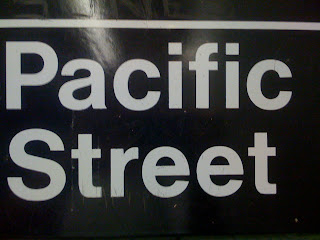 Today I was almost funky enough, so I played across the platform at Pacific Street - the consolation prize of funk, if you will. The two stations are conjoined, and are part of one big complex; depending on which line you’re riding you’re either on the Atlantic or Pacific platforms. The station as a whole apparently has the most transfer opportunities of any MTA station apart from 42nd Street. Many, many ways to leave it, in other words.
It’s also going to be a transport hub and centerpiece of the new ‘Barclays Center’ if the proposed and controversial Atlantic Yards development, featuring the relocated New Jersey Nets, opens as scheduled in 2012.
Whatever it will be though, it wasn’t the source of much of a return today. Any, in fact.
I played in a pretty prominent spot – right by a map – and lots of people were waiting on trains, but none of them felt moved to throw any change my way. I’m starting to realize that maybe the little Martin just isn’t loud enough to battle over platforms that are as busy as the ones I’ve been playing at recently. People have to come too close to hear what you’re actually playing.
I’m going to try the Yamaha for a few days and see if it changes my fortunes.
Today’s Songlist:
Waitin’ On The World To Change – John Mayer
Here Comes The Sun – Beatles
Little Sister –Ry Cooder
Tumblin’ Dice – Rolling Stones
Walking In Memphis – Marc Cohn
Lawyers, Guns And Money – Warren Zevon
How Can A Poor Man Stand Such Times And Live – Bruce Springsteen
Bad Moon Rising – John Fogerty
The Ties That Bind – Bruce Springsteen
Waiting For My Real Life To Begin – Colin Hay
Peace Love And Understanding – Elvis Costello
Rosalita – Bruce Springsteen
******************************
I’ve seen this Pan Flute player around a few times in the past couple of weeks. Sometimes he has just one little amp, sometimes it’s a much bigger deal, with percussion and other accoutrements. I wanted to talk to him today, but his song never actually seemed to finish. I’ll catch up with him another time. By the way, I thought it was hilarious that he had chosen to set up next to a poster for a new talent/weight loss reality show called "Dance Your Ass Off".
******************************
Jobs news – I recently applied for a relatively senior editorial position at xxxxxx. They took a pass but said their ‘career center profiler’ would alert me the moment a job matching my experience and preferences became available.
Yeah right, I thought. But, sure enough, I get an email from their keyword bot this morning telling me that not one but two jobs matching my profile are now open for applications.
Both of them are in Africa.
******************************
A former colleague of mine, Peter Kafka, started an interesting ball rolling on his blog the other day, about the economics of online-only local “papers”. Take a look and especially read the comments; which touch on topics from salaries for ‘newsgatherers’ to a breakdown for the sort of projected pageviews needed to prosper. An interesting thread indeed.
******************************
Finally, for old times’ sake, here’s the Average White Band from a few years back playing in St Maarten. Who’d have thought nice Scottish boys had that much funk in them?
Now, I know that their song was written about some upmarket street in Brazil, not the Brooklyn thoroughfare that takes you down by Target and Party City and past the Ex-Lax Building towards the waterfront; but since I’ve lived in this part of the borough for a while I wanted to feel funky enough to someday come and play here.
 Today I was almost funky enough, so I played across the platform at Pacific Street - the consolation prize of funk, if you will. The two stations are conjoined, and are part of one big complex; depending on which line you’re riding you’re either on the Atlantic or Pacific platforms. The station as a whole apparently has the most transfer opportunities of any MTA station apart from 42nd Street. Many, many ways to leave it, in other words.
It’s also going to be a transport hub and centerpiece of the new ‘Barclays Center’ if the proposed and controversial Atlantic Yards development, featuring the relocated New Jersey Nets, opens as scheduled in 2012.
Whatever it will be though, it wasn’t the source of much of a return today. Any, in fact.
I played in a pretty prominent spot – right by a map – and lots of people were waiting on trains, but none of them felt moved to throw any change my way. I’m starting to realize that maybe the little Martin just isn’t loud enough to battle over platforms that are as busy as the ones I’ve been playing at recently. People have to come too close to hear what you’re actually playing.
I’m going to try the Yamaha for a few days and see if it changes my fortunes.
Today’s Songlist:
Waitin’ On The World To Change – John Mayer
Here Comes The Sun – Beatles
Little Sister –Ry Cooder
Tumblin’ Dice – Rolling Stones
Walking In Memphis – Marc Cohn
Lawyers, Guns And Money – Warren Zevon
How Can A Poor Man Stand Such Times And Live – Bruce Springsteen
Bad Moon Rising – John Fogerty
The Ties That Bind – Bruce Springsteen
Waiting For My Real Life To Begin – Colin Hay
Peace Love And Understanding – Elvis Costello
Rosalita – Bruce Springsteen
******************************
I’ve seen this Pan Flute player around a few times in the past couple of weeks. Sometimes he has just one little amp, sometimes it’s a much bigger deal, with percussion and other accoutrements. I wanted to talk to him today, but his song never actually seemed to finish. I’ll catch up with him another time. By the way, I thought it was hilarious that he had chosen to set up next to a poster for a new talent/weight loss reality show called "Dance Your Ass Off".
******************************
Jobs news – I recently applied for a relatively senior editorial position at xxxxxx. They took a pass but said their ‘career center profiler’ would alert me the moment a job matching my experience and preferences became available.
Yeah right, I thought. But, sure enough, I get an email from their keyword bot this morning telling me that not one but two jobs matching my profile are now open for applications.
Both of them are in Africa.
******************************
A former colleague of mine, Peter Kafka, started an interesting ball rolling on his blog the other day, about the economics of online-only local “papers”. Take a look and especially read the comments; which touch on topics from salaries for ‘newsgatherers’ to a breakdown for the sort of projected pageviews needed to prosper. An interesting thread indeed.
******************************
Finally, for old times’ sake, here’s the Average White Band from a few years back playing in St Maarten. Who’d have thought nice Scottish boys had that much funk in them?
Tuesday, June 23, 2009
A2 diminished
As a former resident of Ann Arbor, I'm saddened to hear that it will become the first US city to lose its only daily paper when the News closes next month.
At first look, you'd think the sort of potential reader demographic in a place like that would be able to sustain a well-run local paper, but it will be interesting to see how the transition to a web-only publication (twice-weekly) works out.
At first look, you'd think the sort of potential reader demographic in a place like that would be able to sustain a well-run local paper, but it will be interesting to see how the transition to a web-only publication (twice-weekly) works out.
Monday, June 22, 2009
'Shame...'
Since I've been out of town for the past few days, I'd missed this story about Dan Froomkin being let go by the Washington Post. In my previous life working on my PhD, Dan had graciously taken the time to meet me for lunch and talk about his work blogging the White House. He's a clever writer with a wonderful sense of humor and I always found him enthusiastic and helpful. I'm guessing he wont be without a home for long.
Wednesday, June 17, 2009
'Share it fairly but don't take a slice of my pie'
Last night’s panel at Columbia came up with some interesting thoughts around what sort of job the business press had done in its coverage of the current recession.
The general feeling was that it would be fair to charge the media with a broad decline of skepticism – and that’s leaving aside specific complaints about the ratings agencies, who may or may not be lumped in with the ‘press’ – at the same time as a ‘cult of personality’ had grown up around many of our leading business figures.
The lionizing of corporate leaders that had become mainstream in the 1980s had helped feed into a notion that the market was somehow ‘unstoppable’.
There’s nothing wrong with celebrating success, but what’s important is how it’s judged. There were also thoughts about the effect that has had on journalistic access and the relationship between Wall Street and those who cover it.
Asked from the floor 'where's the outrage?', the panel gave the sense not so much that the business press had been negligent in the run-up to the recession, but rather that by being cheerleaders rather than skeptics first and foremost, it's more likely that things get missed that shouldn’t be.
Is it harder to ‘do the right thing’ when conventional wisdom is piled up against you?
On the panel, investor Bill Ackman had some observations around monetizing the web news model – and the value of products like specialist market newsletters; ultra-niche publications that deliver a specific need and realize a high value because they impart genuine knowledge.
But whatever business we’re in, whatever commodity we’re producing: as long as we’re dependent on someone else’s preferences – whims, even – then we can lose sight of what it was that originally gave us value. If we don’t plan for what might happen when those whims no longer include what we’re offering, then we probably deserve to perish.
The general feeling was that it would be fair to charge the media with a broad decline of skepticism – and that’s leaving aside specific complaints about the ratings agencies, who may or may not be lumped in with the ‘press’ – at the same time as a ‘cult of personality’ had grown up around many of our leading business figures.
The lionizing of corporate leaders that had become mainstream in the 1980s had helped feed into a notion that the market was somehow ‘unstoppable’.
There’s nothing wrong with celebrating success, but what’s important is how it’s judged. There were also thoughts about the effect that has had on journalistic access and the relationship between Wall Street and those who cover it.
Asked from the floor 'where's the outrage?', the panel gave the sense not so much that the business press had been negligent in the run-up to the recession, but rather that by being cheerleaders rather than skeptics first and foremost, it's more likely that things get missed that shouldn’t be.
Is it harder to ‘do the right thing’ when conventional wisdom is piled up against you?
On the panel, investor Bill Ackman had some observations around monetizing the web news model – and the value of products like specialist market newsletters; ultra-niche publications that deliver a specific need and realize a high value because they impart genuine knowledge.
But whatever business we’re in, whatever commodity we’re producing: as long as we’re dependent on someone else’s preferences – whims, even – then we can lose sight of what it was that originally gave us value. If we don’t plan for what might happen when those whims no longer include what we’re offering, then we probably deserve to perish.
Wednesday, June 10, 2009
'She must've had the highway blues, you can tell by the way she smiles'

She told me her name was MonaLisa, and she has a smile that could light up a whole subway tunnel.
Even better, she has the voice of an angel. She sings gospel with her belongings alongside her in a shopping cart, and holds out a McDonalds fries cup for donations.
I didn’t ask if she is homeless – we were talking about music – but I gave her a dollar. Exactly one dollar more than I had made that morning.
She asked me if I’d been playing on the Subway and how I was doing. “Not so good,” I said.
“Don’t worry,” she smiled. “You’re probably just in the wrong spot.”
It was the nicest thing anyone could have said to me at that moment.
On a day when if I’d looked just at how much money was in my case, I could have been pretty low – a Three Time Loser, as Bonnie Raitt might say – MonaLisa reminded me that no matter who we are, or where we are, or how much we have, we, hopefully, never lose sight of our basic sense of kindness.
She's an artist - she had a canvas tucked in the cart - but her voice is just terrific. She was doing pretty well with the passing riders, but she took time to talk to me, and that meant a lot. I suggested that we sing a song together. “What do you want to sing?” she said. How about “People Get Ready,” I offered, since I’d just played it a couple of times upstairs.
“Ah, the Black national anthem,” she laughed.
We eventually settled that maybe “Tracks of My Tears” might be a better choice and agreed we’d meet up again to sing together, then she said: “Well, I gotta do my Jesus stuff..”
I suggested that I could maybe record her singing, and she just said: “I don’t really like publicity. But we can be friends?”
So we hugged and parted, but I’m going to go back and sing with her like she promised. And, trust me, you’re going to want to hear that.
I was in a kind of mellow mood this morning and I decided to come and play at West 4th Street, the main Subway stop in the heart of beautiful Greenwich Village. Given the all-pervasive Bob Dylan associations, I thought the least I could do was start and finish with one of his songs.
 There’s something that just connects you historically when you can come out of a station and walk a block and see the venue where Dylan is supposed to have played in New York City for the first time.
Then you can walk a few blocks to Hudson Street and have a relaxed pint in the White Horse Tavern, the famous watering hole frequented by Dylan Thomas and Brendan Behan among others. Bob was apparently a regular when he first arrived in New York, and used to hang out with the Clancy Brothers here.

So I ended up playing at West 4th for about a total of an hour and a half – just over an hour upstairs on the A/C/E platforms, and the rest of the time downstairs on the F/V tracks. I even played right next to the Subway map in the center of the platform, since, in theory, more people would hear.
While I was playing, a couple of people would come over to sit on the seats near where I was and listen. The acoustics are good and there’s plenty of time between trains. They’d tap their feet, and – I swear – one or two let their trains go by to see what I was going to play next.
Did they throw any change? Maybe tomorrow.
But I’m sure I brightened at least one person’s day today, and isn’t that better than staying in bed?
Set List 1: A/C/E tracks:
The Times They Are A-Changin’ – Bob Dylan
Brown Eyed Girl – Van Morrison (although I mix in parts of the excellent Everclear version)
Drift Away – Dobie Gray
Galway Girl – Steve Earle
The Ties That Bind – Bruce Springsteen
Keep It Loose, Keep It Tight – Amos Lee
Not Dark Yet – Bob Dylan
People Get Ready – Curtis Mayfield
Crazy Love – Van Morrison
I Shall Be Released – Bob Dylan
Bad Moon Rising – John Fogerty
Set List 2: F/V tracks:
Look At Miss Ohio – Gillian Welch
Waiting For My Real Life To Begin – Colin Hay
Tracks Of My Tears – Smokey Robinson
People Get Ready – Curtis Mayfield
Hungry Heart – Bruce Springsteen
Queen Jane Approximately – Bob Dylan
************************************
I got an email this afternoon when I got back from busking. It says:
Dear Steve
We have received your application for the position of xxxxxxx Editor, Americas. After careful consideration, we regret to inform you that you have not been selected for this position.
We will retain your candidate file in our database and may inform you of job openings that match your profile if you selected this option. We also invite you to visit our Career Center at xxxxxxx regularly.
Thank you for your interest in xxxxxxx and we wish you all the best in your career.
Sincerely,
xxxxxxxx Recruiting Team
Oh well. Onwards and upwards.
**************************************
Now this is just hilarious.
Monday, June 8, 2009
'Start me up'

It was important to me symbolically that this journey started here. I arrived at the station this morning the same way I used to when I worked at Forbes.
Except this time I’m staying on the platform.
For a year and a half I’d walked past subway musicians here, either on my way to work or my way home. I’d listen and occasionally put a dollar or so in their case, but generally, like everyone else at this busy intersection, I’d walk by and pretty much take them for granted.
As I found out today, it’s not so busy after rush hour.
There was a pan flute player set up on the platform when I arrived: amplified, backing tapes, CDs for sale, the whole deal. We nodded as I passed and I moved down to the other end and opened my guitar case.
It was hot and humid and noisy, but I found a nice corner that was a naturally resonant spot.
When a train pulls in, the sound of its idling is so loud that the passengers getting off can’t hear you if you’re still playing, so you might as well wait until it pulls out and start over, except that now there’s no-one on the platform.
So you end up playing each song maybe twice, or one-and-a-half times, determined by the intervals between trains. Usually that’s two or three minutes; but occasionally it can be a little longer.
But it’s normally long enough for at least one complete song.
I played fourteen songs a couple of times or so, in just over an hour. Here’s the scorecard:
Nods and smiles : Plenty (one guy even sang along with one song)
Change in guitar case : Zero
Nothing. Unless you count the dime I found on the platform (and, yes, I am – it’s possible someone with a really bad throw meant me to have it). So all told I ended up $1.90 out of pocket today.
When I was done, I could hear the pan flute guy was still playing further along the platform, so I went up and waited for the song he was playing to finish, said hello and asked if I could come back and interview him when he wrapped up.
We agreed to meet there at 2.30, so I had lunch and came back at 2.00, with the intention of video-ing him playing, but he was gone. I tried the downtown platform, but no luck (you can pretty much hear when someone is playing anywhere in the station and then just follow the sound), so I got my guitar out and played for another 15-20 minutes in his spot, on the off chance that he might come back.
Then I rode the F train up and downtown for an hour to see if there was anyone playing on the trains before heading home to Brooklyn. The only guy who was getting any action was a beggar whose single selling point, as far as I could tell, was that he had a hat.
HE did better than me today.
But I gave out a few cards and told people about the blog, including a guy who struck up a conversation with me about Billy Bragg and was very useful in pointing me to where some good bands and performers are playing at the moment, under – and over – ground.
As he said though, “there’s no energy on that platform” (at 14th Street). And he’s right. It’s a busy stop, sure, and the MUNY acts who play on the Union Square concourse upstairs have a great stage (I'll get to them later in the week). But the F/V platforms are pretty dead.
But that wasn’t the point of today.
Call it ‘on-the-job training’ if you will, it meant that I know for sure that this is a tough gig. But somehow at the end of it I’d reclaimed this station. The symmetry of starting where I’d finished a year ago was significant.
Tomorrow will be better. And I learned that when I have a potential interview, especially with the ‘genuine sound of the Andes’, I’ll try to do it there and then.
So in total, I played for about 70 minutes this morning, then maybe another 15-to-20 this afternoon when the pan flutist was a no-show.
An hour and a half.
For a dime.
But I’m not discouraged.
The first time I ever played in the subway, about fifteen years ago in London, it was pretty much by accident. I was bringing a guitar back from being restrung at a shop in Denmark Street. After wandering around downtown for a while I went into Green Park tube station to head home. For whatever reason, there were delays on the line I needed, so I found myself in the passage between the escalators and the platform. Someone shouted “give us a tune, then”, so I opened my case, got out my guitar – an old Washburn as I remember; I no longer have it – and played a few verses of “Knockin’ On Heaven’s Door”. No money whatsoever. Nada.
Fair enough. The only way is up.
Today’s songlist:
Waiting For My Real Life To Begin – Colin Hay
Here Comes The Sun – The Beatles
Knockin’ On Heaven’s Door – Bob Dylan
I Won’t Back Down – Tom Petty
Shattered Cross – Stuart Adamson
The Weight – The Band
The Promised Land – Bruce Springsteen
Who’ll Stop The Rain – John Fogerty
The Only Living Boy In New York – Paul Simon
You’re The World To Me – David Gray
How Can A Poor Man Stand Such Times And Live? – Bruce Springsteen
The Waiting – Tom Petty
Romeo and Juliet – Dire Straits
Peace Love and Understanding – Elvis Costello
*********************************************************
Thanks to Neil Cossar’s excellent book ‘This Day In Music’ (Collins and Brown), we learn that on June 8th 1967, The Beatles’ “Sgt Pepper” went to Number One in the British album charts. It cost 25,000 pounds ( about $42,000) to produce, and required over 700 hours of studio time. It was also the first album to print the song lyrics on the sleeve.
*********************************************************
I had a headhunter call me a few months back, to ask if I was interested in working here. I told her that no matter how broke or desperate I was, I simply could not, because part of my soul would be taken that I could never hope to get back. To which she said: “so that’s a no, then?”
Sunday, June 7, 2009
‘Keep pushin’ til it’s understood…’
I love Gawker. Nick Denton and I were colleagues at the Financial Times and I read it regularly. I’m grateful for their mention the other day, but I have to quickly clarify something before this project starts.
Nowhere on my blog does it say I was laid off. I wasn’t. I took a voluntary buyout from the FT and then I quit the job at Forbes.
If I hadn’t left Forbes when I did, I most likely would have been among the folks they let go over the next few months, but obviously I can’t know that for sure.
The job I had lined up when I left there fell through after that shop laid off a lot of people and imposed a hiring freeze.
But to clarify, I walked away of my own choice. The fact that I haven’t been able to find a job since, and have burned through my savings, is no-one’s failing but my own.
So no big deal, I just wanted to keep things straight. I hope Hamilton’s offer to crack the change is still good.
And this was by far my favourite reader comment:
"In the 80's everyone wanted to be coke dealers like in Miami Vice; in the 90's everyone wanted to be in Friends. Now everyone wants to be an insufferable twat from "This American Life".
My wife read it and just said: “aw, honey. You’re not that insufferable.”
Nowhere on my blog does it say I was laid off. I wasn’t. I took a voluntary buyout from the FT and then I quit the job at Forbes.
If I hadn’t left Forbes when I did, I most likely would have been among the folks they let go over the next few months, but obviously I can’t know that for sure.
The job I had lined up when I left there fell through after that shop laid off a lot of people and imposed a hiring freeze.
But to clarify, I walked away of my own choice. The fact that I haven’t been able to find a job since, and have burned through my savings, is no-one’s failing but my own.
So no big deal, I just wanted to keep things straight. I hope Hamilton’s offer to crack the change is still good.
And this was by far my favourite reader comment:
"In the 80's everyone wanted to be coke dealers like in Miami Vice; in the 90's everyone wanted to be in Friends. Now everyone wants to be an insufferable twat from "This American Life".
My wife read it and just said: “aw, honey. You’re not that insufferable.”
Thursday, June 4, 2009
'And what don't you do for a living?'
I’ve been a journalist for 25 years. And on Monday I’ll have been an unemployed journalist for one year.
I’ve been freelancing a bit, and doing some editorial consulting, but I haven’t had what used to be considered a ‘real’ job for a while. And I’m coming to the conclusion, like the increasing number of folks in a similar boat, that I’ll probably never work in a traditional newsroom again. Or perhaps even for a traditional news organization.
But you know what? That’s not necessarily a bad thing. Every industry needs a regular infusion of new blood and there are lots of enthusiastic and talented young people out there who – while they’ll undoubtedly face challenges – will find new opportunities as we go through this economic shakeout and media companies re-organize themselves.
I wanted to be a journalist from the time I was 15. My English teacher’s wife had been Belfast correspondent for the Irish Times and telling stories sounded like just the coolest thing anyone could do. I worked hard and found myself in the right place at the right time on a couple of crucial occasions. And journalism treated me right. I’ve no complaints.
As Thomas Edison said: when you're doing something you love, you never work a day in your life.
 I spent 17 years with the Financial Times, in both London and New York, starting on the copy desk with a six-month contract, then working on staff for the International Edition. I was able to combine my academic interests with work – I wound up writing about every US presidential election since 1988 – before I joined the team to set up the paper’s online edition, FT.com.
A few years ago, I wrote about the early days and how we established the site for a special section marking FT.com's 10th anniversary.
In 2006 I took one of a second round of newsroom buyouts the paper was offering and moved to New York to follow my American wife, who had been offered a dream job she couldn't pass up back home.
I had a great time at the FT; I made some very good friends and like everyone else there I had the sense that we were part of something special. I changed jobs within the paper often enough that there was always a new challenge.
While the FT and I were well-matched, Forbes and I just weren’t the “right fit”. If I hadn’t left there when I did, I’d likely have been let go in the layoffs that followed over the next few months. But there are still some good, talented people there and I wish them well.
When I left, I had another job lined up, but after three interviews - including one with HR – the company announced it was laying off a significant number of editorial staff and everything was put on hold. The worst thing about that experience was that I had to call them to find out what had happened.
And that was the beginning of the big industry-wide slide.
My biggest mistake, I guess, was not to look around more before I went to Forbes. I got the gig and thought there was no reason to play the field. Now, with opportunities harder to come by, I wish I had explored other options.
But that’s all neither here nor there.
Over the past few months, I’ve probably shipped my resume out to about forty news organizations, and I’ve applied for specific jobs at places like US News and World Report, CNN, The New York Times, ProPublica, Wall Street Journal, Reuters (for two separate positions), New York Daily News, Huffington Post, New York Observer, and Newsweek.
I’ve also thought about exploring other fields, like PR or management consulting, as well as teaching, which I’ve always enjoyed. Just the other day a friend from FT days, who took a buyout around the same time as me and previously had a good career at CNN, gave up looking for a job after a year and started a Masters’ program in Education.
So what does a mid-life journalist do when they’re out of work?
Obviously, they can go and sing in the subway, hence this project; but they’re also thinking every day about how they might fit into whatever model of the media industry comes out the other side of this recession.
And whether or not they’ll even want to.
But our profession, of course, isn't alone. At the end of May, about 14.5 million Americans were unemployed, 9.4 per cent of the total workforce - the highest percentage for 25 years. According to the AP: "if laid-off workers who have given up looking for new jobs or have settled for part-time work are included, the unemployment rate would have been 16.4 per cent."
So at the same time as journalism is re-inventing itself, people’s understanding of the whole nature of work is being re-evaluated.
Now, when a job ad asks for “salary requirements”, it’s basically an auction to see who’ll do it for the lowest number. Companies are regularly asking employees to take a pay cut, give up vacation days or work extra hours for free in order to trim costs and make it slightly less likely that their jobs will be lost. It also means, I guess, that when they eventually do get laid off, their payoffs will be smaller.
Some companies are even – God help us – selling their unpaid internships.
Don’t get me wrong; I don’t have a sense of entitlement to a job, and I’m not whining about not having one. I am where I am through my own decisions. But as I watch news organizations struggle with fewer resources, the difficult thing for me to wrestle with is what seems to be valued in “news”.
When it’s more important than ever that people understand how they’re affected by some of the most crucial issues of our time, audiences don’t seem interested unless it’s presented in a slam-bang, celebrity-laced, short-attention-span theatre version, where discourse usually involves two talking heads cancelling each other out.
And if the audience isn't hooked, neither are the advertisers.
On the other side of the coin, though, there are reasons to be upbeat about long form, narrative journalism that has at its heart a mission to explain, rather than just entertain. Yesterday, I was at a lunch honoring the winners of this year’s Livingston Awards, young journalists who have created some remarkably good work, backed by news organizations that understand why it's important.
I’m optimistic about the profession, but it’ll be a tough road. The companies that are left standing, let alone prosper, at the end of this dip will be different animals indeed.
Thinking about the future of media (and newspapers in particular) from economics to content structure to delivery systems, to understanding the nature of the audience, is something I’ve always been passionate about. I regularly read smart media pundits like Jay Rosen or Jeff Jarvis - on Jarvis's Buzzmachine recently there was a good discussion based around an FT editorial on the future of newspapers - and, always, my friend John Naughton.
I'm planning to keep on top of industry developments and broader media debates while I’m doing this storytelling project; I’ll post and discuss some relevant items and hopefully find out what others think.
But here’s a final thought for now: maybe the slide towards a lowest common denominator populism in our mass culture is inevitable. Hasn’t it always been?
WSJ legend Barney Kilgore once said that the easiest thing a reader can do is stop reading; and writers and editors have always understood the need to grab and hold onto an audience.
So the challenge becomes finding a combination of enlightenment and entertainment; reminding readers why good journalism is good for them, while giving them enough of what they might really want so we can pay our bills.
After all, remember the old Fleet Street rhyme from the early 20th century?
“Tickle the public, make them grin,
The more you tickle, the more you win;
Teach the public, you’ll never get rich,
You’ll live like a beggar and die in a ditch.”
I’ve been freelancing a bit, and doing some editorial consulting, but I haven’t had what used to be considered a ‘real’ job for a while. And I’m coming to the conclusion, like the increasing number of folks in a similar boat, that I’ll probably never work in a traditional newsroom again. Or perhaps even for a traditional news organization.
But you know what? That’s not necessarily a bad thing. Every industry needs a regular infusion of new blood and there are lots of enthusiastic and talented young people out there who – while they’ll undoubtedly face challenges – will find new opportunities as we go through this economic shakeout and media companies re-organize themselves.
I wanted to be a journalist from the time I was 15. My English teacher’s wife had been Belfast correspondent for the Irish Times and telling stories sounded like just the coolest thing anyone could do. I worked hard and found myself in the right place at the right time on a couple of crucial occasions. And journalism treated me right. I’ve no complaints.
As Thomas Edison said: when you're doing something you love, you never work a day in your life.
 I spent 17 years with the Financial Times, in both London and New York, starting on the copy desk with a six-month contract, then working on staff for the International Edition. I was able to combine my academic interests with work – I wound up writing about every US presidential election since 1988 – before I joined the team to set up the paper’s online edition, FT.com.
A few years ago, I wrote about the early days and how we established the site for a special section marking FT.com's 10th anniversary.
In 2006 I took one of a second round of newsroom buyouts the paper was offering and moved to New York to follow my American wife, who had been offered a dream job she couldn't pass up back home.
I had a great time at the FT; I made some very good friends and like everyone else there I had the sense that we were part of something special. I changed jobs within the paper often enough that there was always a new challenge.
While the FT and I were well-matched, Forbes and I just weren’t the “right fit”. If I hadn’t left there when I did, I’d likely have been let go in the layoffs that followed over the next few months. But there are still some good, talented people there and I wish them well.
When I left, I had another job lined up, but after three interviews - including one with HR – the company announced it was laying off a significant number of editorial staff and everything was put on hold. The worst thing about that experience was that I had to call them to find out what had happened.
And that was the beginning of the big industry-wide slide.
My biggest mistake, I guess, was not to look around more before I went to Forbes. I got the gig and thought there was no reason to play the field. Now, with opportunities harder to come by, I wish I had explored other options.
But that’s all neither here nor there.
Over the past few months, I’ve probably shipped my resume out to about forty news organizations, and I’ve applied for specific jobs at places like US News and World Report, CNN, The New York Times, ProPublica, Wall Street Journal, Reuters (for two separate positions), New York Daily News, Huffington Post, New York Observer, and Newsweek.
I’ve also thought about exploring other fields, like PR or management consulting, as well as teaching, which I’ve always enjoyed. Just the other day a friend from FT days, who took a buyout around the same time as me and previously had a good career at CNN, gave up looking for a job after a year and started a Masters’ program in Education.
So what does a mid-life journalist do when they’re out of work?
Obviously, they can go and sing in the subway, hence this project; but they’re also thinking every day about how they might fit into whatever model of the media industry comes out the other side of this recession.
And whether or not they’ll even want to.
But our profession, of course, isn't alone. At the end of May, about 14.5 million Americans were unemployed, 9.4 per cent of the total workforce - the highest percentage for 25 years. According to the AP: "if laid-off workers who have given up looking for new jobs or have settled for part-time work are included, the unemployment rate would have been 16.4 per cent."
So at the same time as journalism is re-inventing itself, people’s understanding of the whole nature of work is being re-evaluated.
Now, when a job ad asks for “salary requirements”, it’s basically an auction to see who’ll do it for the lowest number. Companies are regularly asking employees to take a pay cut, give up vacation days or work extra hours for free in order to trim costs and make it slightly less likely that their jobs will be lost. It also means, I guess, that when they eventually do get laid off, their payoffs will be smaller.
Some companies are even – God help us – selling their unpaid internships.
Don’t get me wrong; I don’t have a sense of entitlement to a job, and I’m not whining about not having one. I am where I am through my own decisions. But as I watch news organizations struggle with fewer resources, the difficult thing for me to wrestle with is what seems to be valued in “news”.
When it’s more important than ever that people understand how they’re affected by some of the most crucial issues of our time, audiences don’t seem interested unless it’s presented in a slam-bang, celebrity-laced, short-attention-span theatre version, where discourse usually involves two talking heads cancelling each other out.
And if the audience isn't hooked, neither are the advertisers.
On the other side of the coin, though, there are reasons to be upbeat about long form, narrative journalism that has at its heart a mission to explain, rather than just entertain. Yesterday, I was at a lunch honoring the winners of this year’s Livingston Awards, young journalists who have created some remarkably good work, backed by news organizations that understand why it's important.
I’m optimistic about the profession, but it’ll be a tough road. The companies that are left standing, let alone prosper, at the end of this dip will be different animals indeed.
Thinking about the future of media (and newspapers in particular) from economics to content structure to delivery systems, to understanding the nature of the audience, is something I’ve always been passionate about. I regularly read smart media pundits like Jay Rosen or Jeff Jarvis - on Jarvis's Buzzmachine recently there was a good discussion based around an FT editorial on the future of newspapers - and, always, my friend John Naughton.
I'm planning to keep on top of industry developments and broader media debates while I’m doing this storytelling project; I’ll post and discuss some relevant items and hopefully find out what others think.
But here’s a final thought for now: maybe the slide towards a lowest common denominator populism in our mass culture is inevitable. Hasn’t it always been?
WSJ legend Barney Kilgore once said that the easiest thing a reader can do is stop reading; and writers and editors have always understood the need to grab and hold onto an audience.
So the challenge becomes finding a combination of enlightenment and entertainment; reminding readers why good journalism is good for them, while giving them enough of what they might really want so we can pay our bills.
After all, remember the old Fleet Street rhyme from the early 20th century?
“Tickle the public, make them grin,
The more you tickle, the more you win;
Teach the public, you’ll never get rich,
You’ll live like a beggar and die in a ditch.”
Friday, May 1, 2009
'Well I started out to God knows where,
Guess I'll know when I get there...'
Every story starts somewhere. This one starts in midtown Manhattan on a bright, chilly afternoon in March.
It’s the day before my 48th birthday and things are not, shall we say, working out as well as I’d hoped.
I’ve been a journalist for about twenty-five years – arguably journalism's most interesting quarter-century - and every day I'm watching the promise of new technology tailspin into an accelerating meltdown of some long-standing media institutions. At the same time, a general dumbing-down and relentless pursuit of the trivial has meant it's harder than ever for good journalism to prosper.
For reasons you'll hear more about as we go on, I haven't had a 'real' job for almost a year, and the search for work has been taking its toll. The fact that the economy is tanking and my chosen profession is self-destructing around me doesn’t offer much encouragement that things are going to get better anytime soon.
I’d just come from lunch with my long-suffering wife, who’d been trying to 'snap me out of it', and my last words to her before I walk to the subway station are: “I never thought I’d feel I have nothing worthwhile to offer anymore." She sighed her usual little tolerant sigh, we said goodbye and I got on the subway at 51st and Lex, to ride the V train downtown to 14th Street, where I'd change to the F and go home to Brooklyn.
On the F train platform, I stood looking at the oncoming lights and wondering - as I’m sure many people have done on many platforms - what it would feel like: a brief moment of flight, and then nothing. But the train stops, I get on and for the next couple of stations I’m numb, thinking about how, deep down, I’m too big a coward for what would be the ultimate selfish act.
But then something amazing happens.
The doors open and three young African-American men bound into the carriage carrying huge, bright red bongo drums. In the crooks of their arms they have small folding chairs. They’re dressed like they brought their own rainbow with them, and they start by announcing the usual “sorry to disturb your journey folks…” that subway riders hear pretty much every day.
With that, the guy who’s talking looks straight at me.
Whether it’s just being overwhelmed by the sudden flash of color amid the drabness, or whatever, I realize I’m smiling. And he says: “That’s right! We’re only here to put a smile on your face and let you know that whoever you are, the groove can touch your soul.”
They unfold their chairs, sit down by the doors with the drums between their knees and they start to play. It’s perfect. It’s a rhythm they must have hammered out a hundred times together, as they kick in with flawless synchronization and catch each other’s eyes when it’s time to slide the tempo up, and then stop, simultaneously, with a series of slaps.
In those two minutes or so, there is something undeniably infectious and even life-affirming.
Their timing is impeccable: the train eases into the next station as they fold up their chairs and get ready to leap back out onto the platform, while one of them dances from passenger to passenger, proffering a smile and a colorful upturned hat.
There must have been about twenty people in the carriage - admittedly, one man holding a cat in an animal carrier got up and moved away shaking his head once the stealth percussionists arrived – but at least half of them, including me, put some paper into the collection.
But the thing that hit me most while they were playing was looking around at my fellow passengers and realizing that most of them were, like me, either smiling or tapping their feet, or nodding their head. Only a few were making a point to look away.
And it struck me: this isn’t about money. This is about making a human connection in a world where there are way too few. This is one person – or in this case, three – putting themselves out there and saying ‘here we are: let’s try to make all our lives a little better, even in the time it takes to travel between stations.’
There are two things that we sometimes take for granted: the city we live in, and music’s power to reach us. A combination of the two is, for me, irresistible. I want to find out more about this world under Gotham; who chooses to do this and why, what it means to them and what they get out of it.
That’s why I plan to spend this summer – this unprecedented summer of mad money and media meltdown – singing and playing under the streets of New York, and getting to know some of the musicians whose stage is a subway platform.
Between June and August, I’ll busk for a couple of hours a day, starting out at forty-eight different subway stations around the MTA map and see where the day leads, and the subway musicians it leads me to. I’ll keep a diary of who I meet, what I see and what’s going on in the ‘real world’, as well as a list of the songs I play and how much money I make.
We only get one go round, so even for a little while, I’m going to try to connect music's universal language with people's everyday lives and see if we can’t find something joyous beneath the surface.
At least there should be a few good stories to tell. And that, I think, is what I've been missing.

It’s the day before my 48th birthday and things are not, shall we say, working out as well as I’d hoped.
I’ve been a journalist for about twenty-five years – arguably journalism's most interesting quarter-century - and every day I'm watching the promise of new technology tailspin into an accelerating meltdown of some long-standing media institutions. At the same time, a general dumbing-down and relentless pursuit of the trivial has meant it's harder than ever for good journalism to prosper.
For reasons you'll hear more about as we go on, I haven't had a 'real' job for almost a year, and the search for work has been taking its toll. The fact that the economy is tanking and my chosen profession is self-destructing around me doesn’t offer much encouragement that things are going to get better anytime soon.
I’d just come from lunch with my long-suffering wife, who’d been trying to 'snap me out of it', and my last words to her before I walk to the subway station are: “I never thought I’d feel I have nothing worthwhile to offer anymore." She sighed her usual little tolerant sigh, we said goodbye and I got on the subway at 51st and Lex, to ride the V train downtown to 14th Street, where I'd change to the F and go home to Brooklyn.
On the F train platform, I stood looking at the oncoming lights and wondering - as I’m sure many people have done on many platforms - what it would feel like: a brief moment of flight, and then nothing. But the train stops, I get on and for the next couple of stations I’m numb, thinking about how, deep down, I’m too big a coward for what would be the ultimate selfish act.
But then something amazing happens.
The doors open and three young African-American men bound into the carriage carrying huge, bright red bongo drums. In the crooks of their arms they have small folding chairs. They’re dressed like they brought their own rainbow with them, and they start by announcing the usual “sorry to disturb your journey folks…” that subway riders hear pretty much every day.
With that, the guy who’s talking looks straight at me.
Whether it’s just being overwhelmed by the sudden flash of color amid the drabness, or whatever, I realize I’m smiling. And he says: “That’s right! We’re only here to put a smile on your face and let you know that whoever you are, the groove can touch your soul.”
They unfold their chairs, sit down by the doors with the drums between their knees and they start to play. It’s perfect. It’s a rhythm they must have hammered out a hundred times together, as they kick in with flawless synchronization and catch each other’s eyes when it’s time to slide the tempo up, and then stop, simultaneously, with a series of slaps.
In those two minutes or so, there is something undeniably infectious and even life-affirming.
Their timing is impeccable: the train eases into the next station as they fold up their chairs and get ready to leap back out onto the platform, while one of them dances from passenger to passenger, proffering a smile and a colorful upturned hat.
There must have been about twenty people in the carriage - admittedly, one man holding a cat in an animal carrier got up and moved away shaking his head once the stealth percussionists arrived – but at least half of them, including me, put some paper into the collection.
But the thing that hit me most while they were playing was looking around at my fellow passengers and realizing that most of them were, like me, either smiling or tapping their feet, or nodding their head. Only a few were making a point to look away.
And it struck me: this isn’t about money. This is about making a human connection in a world where there are way too few. This is one person – or in this case, three – putting themselves out there and saying ‘here we are: let’s try to make all our lives a little better, even in the time it takes to travel between stations.’
There are two things that we sometimes take for granted: the city we live in, and music’s power to reach us. A combination of the two is, for me, irresistible. I want to find out more about this world under Gotham; who chooses to do this and why, what it means to them and what they get out of it.
That’s why I plan to spend this summer – this unprecedented summer of mad money and media meltdown – singing and playing under the streets of New York, and getting to know some of the musicians whose stage is a subway platform.
Between June and August, I’ll busk for a couple of hours a day, starting out at forty-eight different subway stations around the MTA map and see where the day leads, and the subway musicians it leads me to. I’ll keep a diary of who I meet, what I see and what’s going on in the ‘real world’, as well as a list of the songs I play and how much money I make.
We only get one go round, so even for a little while, I’m going to try to connect music's universal language with people's everyday lives and see if we can’t find something joyous beneath the surface.
At least there should be a few good stories to tell. And that, I think, is what I've been missing.

Subscribe to:
Posts (Atom)